
Daewoong Pharmaceutical

Daewoong Pharmaceutical is a South Korean pharmaceutical company with an important botulinum toxin type A business built around Nabota and the U.S.-market product Jeuveau. “Daewoong” is a natural shorthand in market discussion, but the formal company name matters because Daewoong Group, Daewoong Pharmaceutical, Daewoong Bio, and other affiliates can appear in adjacent facility and manufacturing contexts.
The company’s toxin business connects Korean manufacturing, international aesthetic commercialization, regional naming, and the legal history that shaped access to Jeuveau in the United States.
Nabota and Jeuveau are related product identities within Daewoong’s type A toxin business, not a universal global label. The same company relationship does not make every market’s product information, approved indication, vial presentation, or commercial partner identical.
Quick Answers
Section titled “Quick Answers”| Common question | Short answer |
|---|---|
| Who makes Jeuveau? | Jeuveau is the U.S. brand for prabotulinumtoxinA-xvfs. Daewoong is the Korean product-origin and manufacturing node, while Evolus is the U.S. label holder and commercial company. |
| What is the relationship between Nabota, Jeuveau, and Nuceiva? | Nabota is the Daewoong-origin product-family name, Jeuveau is the U.S. Evolus brand, and Nuceiva is used in selected international Evolus markets. Local labels and approvals still control interpretation. |
| Is Daewoong the same as Evolus? | No. Daewoong developed and manufactures the Nabota product family; Evolus commercializes Jeuveau in the United States and Nuceiva in several selected markets. |
| Does the shared product family make the names interchangeable? | No. Nabota, Jeuveau, and Nuceiva should not be treated as one universal label, dose scale, indication set, or approval status. |
Reference card
Section titled “Reference card”| Field | Reference point |
|---|---|
| Company | Daewoong Pharmaceutical Co., Ltd. |
| Base | South Korea |
| Website | daewoong.com |
| Listing status | KOSPI-listed; ticker code 069620:KRX |
| Core toxin relationship | Developer and manufacturer of Nabota, a botulinum toxin type A product line |
| Main toxin names | Nabota; Jeuveau in the United States and other Evolus-associated aesthetic markets; Nuceiva in parts of Europe |
| Key commercial relationship | Evolus holds important aesthetic-market commercialization rights for Jeuveau and Nuceiva in several territories. |
| Manufacturing footprint | Daewoong lists a Nabota Plant in Hyangnam, Hwaseong, South Korea; related Daewoong Bio facilities sit nearby but should not be treated as Nabota manufacturing sites unless the source says so. |
| Comparison anchors | Botox, Dysport, Xeomin, Letybo, and Medytox |
| Unit context | Jeuveau labeling states that its potency assay is product-specific and its units cannot be converted into units of another botulinum toxin product. |
Related People
Section titled “Related People”| Person | Why the relationship matters |
|---|---|
| Seng-ho Jeon | Daewoong Pharmaceutical Co-CEO, useful for connecting Nabota sales growth, Jeuveau manufacturing context, and Korea-origin toxin expansion to company leadership. |
Selected history
Section titled “Selected history”-
2014: Nabota released in Korea Daewoong history materials list the Korean release of Nabota in 2014 and describe the product as a botulinum toxin developed by Daewoong.
-
2019: U.S. approval and launch of Jeuveau U.S. prescribing information lists Jeuveau, prabotulinumtoxinA-xvfs, with initial U.S. approval in 2019. Daewoong history materials describe Jeuveau’s U.S. launch that year through the company’s international commercialization pathway.
-
2020-2021: U.S. trade-secret dispute and settlement The U.S. International Trade Commission found a Section 337 violation in 2020 involving Daewoong, Evolus, and Medytox manufacturing-process trade secrets. Later settlement activity allowed Jeuveau commercialization to continue in Evolus territories; the dispute should be understood as legal and market-structure context, not as evidence of clinical superiority or inferiority.
-
2020-2022: broader international expansion Daewoong materials list Nabota authorizations or launches across several markets, including Taiwan, Brazil, Saudi Arabia, Ukraine, and Europe-related commercialization. Each market still requires its own product information and approval context.
Product portfolio
Section titled “Product portfolio”Daewoong’s toxin portfolio is concentrated around a single type A product family presented through different market names. That makes the portfolio easier to map than multi-line manufacturers such as Medytox, but it also increases the risk of treating market names as interchangeable without checking the local label.
| Product name | Main context | Presentation / label context | Market and approval boundary |
|---|---|---|---|
| Nabota | Daewoong’s Korean and export-associated botulinum toxin type A name. | Daewoong reports Nabota as a Korea-developed botulinum toxin product and lists the dedicated Nabota Plant in Hyangnam. | Nabota’s Korean and export identity does not automatically establish identical approvals or indications in every market. |
| Jeuveau | U.S. and Evolus-associated aesthetic-market name for prabotulinumtoxinA-xvfs. | U.S. labeling describes Jeuveau as a sterile, vacuum-dried powder in a single-dose vial for intramuscular use after reconstitution. | U.S. approval is tied to glabellar lines in adults; units are product-specific and not convertible to other toxins. |
| Nuceiva | Market name associated with Evolus commercialization in parts of Europe. | Daewoong history materials refer to a European launch under the Nuceiva name. | European-market naming should not be read as a U.S. label or a universal Nabota synonym. |
Nabota
Section titled “Nabota”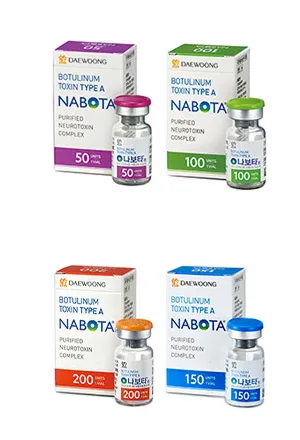
Nabota is the Daewoong name most directly tied to the company’s Korean manufacturing and export identity. Daewoong describes Nabota as a botulinum toxin type A product and lists a dedicated Nabota Plant in Hyangnam, Hwaseong. The product is part of the same market conversation as Botox, Dysport, Xeomin, Letybo, and other type A toxins, but the comparison should stay anchored to product-specific labeling and evidence.
Daewoong’s public materials describe Nabota expansion across multiple regions, including the United States through Jeuveau, Europe through Evolus-associated commercialization, and other markets such as Brazil and Taiwan. Those facts are useful for market mapping. They do not mean that Nabota, Jeuveau, and Nuceiva have one identical indication set, approved-use language, dosing framework, or regulatory status everywhere.
Jeuveau
Section titled “Jeuveau”Jeuveau is the U.S.-market name for prabotulinumtoxinA-xvfs. In the United States, the DailyMed prescribing information lists Jeuveau for temporary improvement in the appearance of moderate to severe glabellar lines associated with corrugator and/or procerus muscle activity in adult patients.
The U.S. label also gives the clearest unit-safety anchor. It describes the potency assay as specific to Jeuveau and states that Jeuveau units cannot be converted into units of another botulinum toxin product. That matters because Jeuveau often appears in direct comparison discussions with Botox Cosmetic, Dysport, Xeomin, Daxxify, or Letybo, but shared type A biology does not create a shared dose scale.
DailyMed carton-label text lists Jeuveau as designed by Evolus and manufactured at Daewoong Pharmaceuticals in Seoul, Korea. That structure separates brand commercialization from manufacturing identity: Evolus is the U.S. label holder and commercial face, while Daewoong is central to the product’s manufacturing and origin story.
Nuceiva and regional names
Section titled “Nuceiva and regional names”Nuceiva is useful as a regional market identifier associated with Jeuveau/Nabota commercialization in parts of Europe. It should be presented as naming and market context rather than as proof of a universal global product label. Readers comparing product availability across countries should start with local regulator records or country-specific product information.
Sites and affiliate infrastructure
Section titled “Sites and affiliate infrastructure”Daewoong’s toxin manufacturing context is centered on the Hyangnam site that Daewoong identifies as its Nabota Plant. The broader Daewoong ecosystem also includes Daewoong Bio locations in Seoul, Hyangnam, Anseong, and other manufacturing contexts. Those affiliate sites are useful for understanding the group’s pharmaceutical infrastructure, but they should not be collapsed into the Nabota supply chain unless a product-specific source makes that link.
Nabota Plant: Hyangnam, Hwaseong
Section titled “Nabota Plant: Hyangnam, Hwaseong”Daewoong lists the Nabota Plant in Hyangnam as the factory producing botulinum toxin products. Company wording about world-class quality and technological excellence is useful as manufacturer context, but it should not be rewritten as approval by every regulator unless a specific regulator and product approval record says so.
Location: 35-14 Jeyakgongdan 4-gil, Hyangnam-eup, Hwaseong-si, Gyeonggi-do, South Korea.
Daewoong Pharmaceutical headquarters: Seoul
Section titled “Daewoong Pharmaceutical headquarters: Seoul”Daewoong lists its Seoul address as Bongeunsa-ro 114-gil 12, Gangnam-gu. The headquarters matters here because several public contact points for Nabota and licensing activity route through the Seoul office.
Location: 12, Bongeunsa-ro 114-gil, Gangnam-gu, Seoul, Korea.
Market role
Section titled “Market role”Daewoong is one of the clearest examples of Korea-origin botulinum toxin manufacturing becoming part of the global aesthetic-toxin market. Jeuveau gives the company a visible U.S. product node in a category often framed around longer-established Western brands such as Botox, Dysport, and Xeomin, while Nabota remains important to the Korean and international product-identity context.
Daewoong shows how a Korean manufacturer, a U.S. aesthetic company, regional distributors, and regulator-specific labels can all sit behind one familiar product conversation. That structure is useful for market interpretation, but it does not support shortcut claims that Nabota or Jeuveau is stronger, safer, longer-lasting, more precise, or unit-equivalent to another botulinum toxin product.
Litigation and market interpretation
Section titled “Litigation and market interpretation”Daewoong, Evolus, Medytox, and Allergan were part of a prominent U.S. International Trade Commission dispute involving botulinum toxin manufacturing-process trade secrets. The Commission’s 2020 order found a Section 337 violation tied to Medytox manufacturing-process trade secrets, and later settlement activity between AbbVie, Evolus, and Medytox resolved key commercialization barriers for Jeuveau.
That history matters because it affected market access, company relationships, and public discussion around Jeuveau. It should not be turned into a clinical comparison. A trade-secret finding or settlement does not establish that one botulinum toxin product is clinically superior, clinically equivalent, safer, weaker, stronger, or interchangeable with another.
Comparison limits
Section titled “Comparison limits”- Nabota, Jeuveau, and Nuceiva are market-facing names connected to Daewoong’s type A toxin business, but local labels and approvals still control interpretation.
- Jeuveau’s U.S. indication should not be extended to other uses or countries without separate regulatory support.
- Jeuveau units are not interchangeable with units of Botox, Dysport, Xeomin, Letybo, Daxxify, or other botulinum toxin products.
- Manufacturing-site descriptions are not substitutes for product-specific approval records.
- Legal settlements and trade-secret findings shape market structure, not clinical rankings.
References
Section titled “References”- Daewoong official website
- Daewoong global network and Nabota Plant listing
- Daewoong R&D achievements and company history
- Daewoong Bio directions
- Daewoong Bio facility overview
- Daewoong Bio Bio Center
- Daewoong Bio Anseong Center
- Daewoong Pharmaceutical 2023 Sustainability Report
- DailyMed: JEUVEAU prescribing information
- Evolus 2019 Form 10-K: Daewoong agreement context
- U.S. International Trade Commission: Botulinum Toxin Products, Investigation No. 337-TA-1145
- AbbVie, Evolus, and Medytox resolution announcement