Medytox
Medytox is a South Korean biopharmaceutical company with a prominent botulinum toxin type A portfolio. Its product lines connect Korean toxin manufacturing, formulation differences, export naming, regional approval records, and the competitive expansion of newer type A brands.
The company’s four toxin product lines are Meditoxin / Neuronox, INNOTOX, Coretox, and NEWLUX. NEWLUX was developed by subsidiary NUMECO following technology transfer from Medytox. The names sit across different presentations, labels, markets, and regulatory histories; they do not represent one uniform global product. Medytox’s product directory 🔗 lists the portfolio, and its NEWLUX 200U announcement 🔗 explains NUMECO’s development role.
Quick Answers
Section titled “Quick Answers”| Common question | Short answer |
|---|---|
| What products is Medytox known for? | Medytox is associated with several botulinum toxin type A product lines, including Meditoxin / Neuronox, INNOTOX, Coretox, and NEWLUX. |
| What is MT10109L? | MT10109L is a Medytox development-code / regulatory-program name used in reporting for a non-animal-derived liquid botulinum toxin type A product connected to U.S. submission plans. It is not presented here as a separate marketed global brand. |
| Is MT10109L FDA approved? | No approval is established by the cited records. The December 2023 application was not accepted for review in February 2024. Medytox’s May 2026 filing described a planned resubmission, and November 2026 reporting still described U.S. entry as unresolved; neither establishes an accepted new application. See MT10109L and U.S. FDA status. |
| Is MT10109L the same as INNOTOX or NEWLUX? | Do not treat the names as interchangeable. MT10109L is discussed in liquid-toxin U.S. development context, INNOTOX is Medytox’s Korean liquid product line, and NEWLUX is a newer lyophilized product launched through NUMECO. |
| Are Meditoxin, INNOTOX, Coretox, and NEWLUX the same product? | No. They are separate Medytox product lines with different presentations, approval histories, and product-information records. |
| Is Medytox mainly a dispute-history company in the toxin market? | No. The Daewoong / Evolus / AbbVie dispute is important market-structure context, but Medytox’s product identity should be read through its own portfolio, facilities, labels, and regional approvals. |
| Can Medytox products be compared by unit count with Botox, Jeuveau, Letybo, or other toxins? | No. Shared type A biology does not make Medytox products unit-equivalent, interchangeable, equally approved, or clinically ranked against other brands. |
Reference card
Section titled “Reference card”| Field | Reference point |
|---|---|
| Company | Medy-Tox Inc. (Medytox), the English legal name in its May 2026 quarterly report 🔗 |
| Base | South Korea |
| Website | medytox.com 🔗 |
| Listing status | KOSDAQ-listed since January 16, 2009 (company filing 🔗); ticker code 086900:KOSDAQ 🔗 |
| Manufacturing footprint | Three Korean plants in Ochang and Osong; the current locations directory 🔗 also lists Gwanggyo and Osong R&D centers and a Seoul Global Business Center. |
| Core toxin relationship | Developer and manufacturer of botulinum toxin type A products |
| Main toxin names | Meditoxin / Neuronox, INNOTOX, Coretox, NEWLUX |
| Subsidiary product developer | NUMECO, developer of NEWLUX following technology transfer from Medytox (company announcement 🔗) |
| U.S. development code | MT10109L; see the U.S. regulatory history below. |
| Comparison anchors | Botox, Dysport, Xeomin, and Jeuveau |
| Unit context | Shared type A biology does not make brands unit-equivalent, interchangeable, or equally approved across countries. |
Selected history
Section titled “Selected history”-
2006: Meditoxin approval Medytox company materials describe Meditoxin 100U as Korea’s first approved botulinum toxin type A product and the fourth such product globally.
-
2009: KOSDAQ listing Medytox listed on KOSDAQ, making it easier to track the company as a public-market participant rather than only as a product manufacturer.
-
2013-2016: INNOTOX and Coretox Medytox materials describe MFDS approval for INNOTOX as a non-animal-derived liquid formulation in 2013 and Coretox 100U approval in 2016.
-
2021-2024: litigation settlements and NEWLUX The company reached settlements tied to U.S. intellectual-property litigation in 2021 and launched NEWLUX in Korea in 2023, while continuing distribution and manufacturing-expansion activity through 2024.
-
2026: additional NEWLUX approvals NUMECO announced Korean approval for NEWLUX 200U in June and Panama authorization in August, extending the product’s presentation and regional approval records.
The earlier product and listing milestones are recorded in Medytox’s company history 🔗. The 2026 approvals are detailed below.
2026 business and market expansion
Section titled “2026 business and market expansion”In its November 10, 2026 third-quarter announcement 🔗, Medytox reported consolidated revenue of KRW 59.3 billion and operating profit of KRW 15.5 billion. Revenue fell 2.8% year over year, while operating profit rose 74.5%. Botulinum toxin revenue was KRW 35.5 billion. The company reported 17% growth in overseas toxin sales and described a two-brand export strategy using Meditoxin and NEWLUX, alongside continued domestic Coretox sales.
On August 20, 2026, Medytox announced NEWLUX authorization in Panama 🔗, granted to NUMECO by the country’s medicines authority, DNFD. The announcement also identified Peru, Bolivia, the Dominican Republic, and El Salvador as earlier Latin American entries. NUMECO planned to work with the existing local Meditoxin partner; the announcement established authorization and commercial plans, rather than a confirmed date for first NEWLUX sales in Panama.
These developments distinguish overseas commercial growth from the separate U.S. development program. NEWLUX authorizations outside the United States do not establish FDA approval for NEWLUX or MT10109L.
MT10109L and U.S. FDA status
Section titled “MT10109L and U.S. FDA status”MT10109L is Medytox’s non-animal-derived liquid botulinum toxin type A development program. A biologics license application (BLA) is an application for U.S. marketing approval. Medytox’s May 15, 2026 quarterly report 🔗 records the December 2023 submission and February 2024 refusal to accept it for review because a specific validation-test report was missing. The filing states that Medytox met with FDA and planned to supplement and resubmit the application.
Newsway’s August 21, 2026 report 🔗 quoted Medytox as still preparing the resubmission without disclosing a timetable. More recent November 12, 2026 reporting by Dnews 🔗 continued to describe U.S. entry as an outstanding regulatory hurdle and recalled the 2024 filing refusal. These sources do not establish a completed resubmission, acceptance for review, or FDA approval.
That makes MT10109L a regulatory-development identifier, not a U.S.-approved brand name. The earlier filing did not enter substantive FDA review, and a planned resubmission or a manufacturing site designed around FDA cGMP expectations does not equal FDA approval. U.S. approval would require an FDA action tied to the specific product, proposed label, indication, manufacturing controls, and application record. The program’s current stage is also separated from approved products and CRL-stage applications in U.S. botulinum toxin regulatory status.
MT10109L should also be separated from Medytox’s visible product names. It sits closest to the liquid-toxin part of the Medytox portfolio, which is why readers may see it discussed near INNOTOX. It should not be used as a blanket synonym for INNOTOX, NEWLUX, Meditoxin / Neuronox, or Medytox’s entire toxin portfolio unless a source is specifically making that relationship.
Product portfolio
Section titled “Product portfolio”Medytox’s botulinum toxin business includes several type A product lines, led by Meditoxin / Neuronox and followed by INNOTOX, Coretox, and NEWLUX. The names mark more than brand extension: they point to different presentations, product-information records, and approval contexts across markets.
| Product name | First approval or launch context | Presentation | Protein / formulation context |
|---|---|---|---|
| Meditoxin / Neuronox | Korean approval for Meditoxin 100U in 2006; Neuronox is an export-facing product name. | Lyophilized powder for injection. | Type A product using the Hall strain; unit language remains product-specific. |
| INNOTOX | MFDS approval for INNOTOX 25U in 2013, with later unit approvals listed in company history. | Liquid-filled injection. | Medytox describes INNOTOX as a non-animal-derived liquid formulation. |
| Coretox | MFDS approval for Coretox 100U in 2016. | Lyophilized powder for injection. | Korean product information lists botulinum toxin type A 150kD as the active toxin component. |
| NEWLUX | NUMECO obtained Korean approval for 100U in 2023 and 200U in June 2026. | Lyophilized powder for injection. | A separate NUMECO-developed product following technology transfer from Medytox. |
The shared thread across these products is type A toxin biology, while practical details remain product-specific. Cross-brand comparison with Botox, Dysport, Xeomin, Jeuveau, Letybo, Daxxify, or other products depends on product-specific labeling, evidence context, and regional availability rather than broad market language alone.
Meditoxin / Neuronox
Section titled “Meditoxin / Neuronox”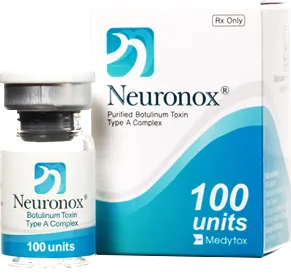
Meditoxin is Medytox’s original botulinum toxin type A product line and the product most closely tied to the company’s early manufacturing identity. Medytox history materials describe KFDA approval for Meditoxin 100U in 2006 and later overseas registration under the Neuronox name.
The Medytox Neuronox product information 🔗 describes a lyophilized white powder for injection with clostridium botulinum toxin type A as the active ingredient. That presentation separates it from INNOTOX’s liquid format, but it does not make the product comparable by unit count to Botox, Dysport, Xeomin, Jeuveau, Letybo, Daxxify, or other type A brands.
Associated export names:
- Botulift
- Acebloc
- Cunox
- Siax
These names reflect market-facing product identities listed by Medytox, while local labeling and approval status remain market-specific.
INNOTOX
Section titled “INNOTOX”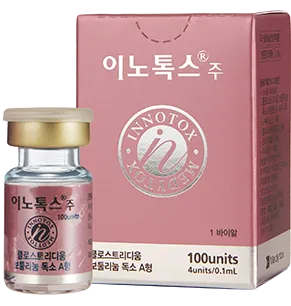
INNOTOX is Medytox’s liquid botulinum toxin type A product line. Medytox history materials describe MFDS approval for INNOTOX 25U in 2013 as a non-animal-derived liquid formulation, followed by later unit approvals.
The liquid presentation is the main practical distinction at the portfolio level: Medytox’s INNOTOX product information 🔗 describes a colorless transparent liquid-filled injection rather than a lyophilized powder that is reconstituted before use. Storage, expiry, indication language, and dose interpretation still belong to the specific product label, not to the broad fact that it is a type A toxin.
INNOTOX should not be treated as a general liquid equivalent of other botulinum toxin products. The format changes handling context, while potency units, approved uses, and clinical decisions remain product- and region-specific.
Coretox
Section titled “Coretox”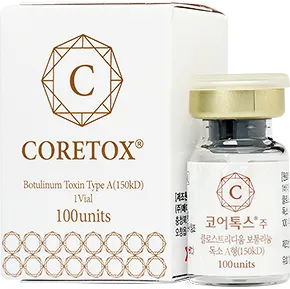
Coretox is a separate Medytox botulinum toxin type A product line approved after Meditoxin and INNOTOX. Medytox history materials list MFDS approval for Coretox 100U in 2016.
Medytox’s R&D portfolio 🔗 identifies Coretox as a type A 150 kDa product; its May 2026 company filing 🔗 describes purification of the neurotoxin component. This distinguishes Coretox’s protein composition from larger toxin complexes without establishing a clinical advantage.
The protein-composition point should be interpreted narrowly. It may matter for formulation comparison and immunogenicity discussion, but it does not by itself establish superior clinical effect, longer duration, lower adverse-event risk, or unit equivalence with other type A products.
Coretox is described by Medytox as a lyophilized powder for injection. As with other toxin products, approved indications and practical use depend on the product label and the market where it is supplied.
NEWLUX
Section titled “NEWLUX”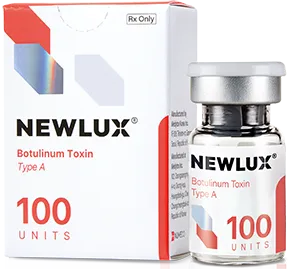
NEWLUX is a botulinum toxin type A product developed by NUMECO after technology transfer from Medytox. Company history records the subsidiary’s renaming from Medytox Korea to NUMECO and NEWLUX’s Korean approval in 2023.
The official NEWLUX product information 🔗 describes NEWLUX 100U as a lyophilized white powder that becomes a clear solution after dilution with saline. It lists Medynox and METATOX as export names; local approvals and labels remain market-specific.
Medytox’s June 22, 2026 announcement 🔗 records MFDS approval for NEWLUX 200U on June 19, with the same formulation and approved uses as Korean NEWLUX 100U. It identifies Osong Plant III Building E as the planned production site. This added a Korean presentation; it did not establish U.S. approval.
NEWLUX is useful to distinguish from Meditoxin / Neuronox because it reflects a newer product cycle and a separate approval context, not because it can be ranked against other Medytox products on broad claims such as strength, safety, or duration. Its interpretation should stay tied to official product information and local regulatory records.
Manufacturing and research sites
Section titled “Manufacturing and research sites”Medytox’s Korean infrastructure connects product manufacturing, formulation development, research, domestic commercialization, and global business coordination. This site network is useful for interpreting Medytox as a manufacturer with multiple product lines, not only as the owner of several toxin brand names.
Plant I: Ochang
Section titled “Plant I: Ochang”Medytox describes Plant I in Ochang as Korea’s first botulinum toxin type A manufacturing facility and as a dedicated site for botulinum toxin and finished-product manufacturing. The company states that Plant I obtained MFDS GMP approval for biologics and injectables.
Location: 78, Gangni-1gil, Ochang-eup, Cheongwon-gu, Cheongju-si, Chungcheongbuk-do, Republic of Korea 🔗.
Plant II: Osong
Section titled “Plant II: Osong”Plant II in Osong is presented by Medytox as a site for liquid-type botulinum toxin type A production, including MT10109L-related manufacturing context. The company describes the facility as designed to meet U.S. FDA cGMP standards and European EMA GMP standards. That wording is facility-design context rather than a statement that the site has FDA or EMA approval.
Plant III: Osong
Section titled “Plant III: Osong”Plant III in Osong is described as a facility for botulinum toxin type A and hyaluronic acid filler products. Medytox describes the site as cGMP / EU GMP compliant in company materials, while the explicit approvals it lists here are Korean KGMP approvals for botulinum toxin production in 2016 and filler production in 2018. In November 2024, Medytox also obtained KGMP approval for the Plant III E-wing, a newer large-scale production line.
R&D center: Gwanggyo
Section titled “R&D center: Gwanggyo”Medytox lists a Gwanggyo R&D Center in Suwon. Its current facilities directory 🔗 also lists an Osong R&D Center, separately from the three production plants.
Gwanggyo R&D Center: 114, Central-Town-ro, Yeongtong-gu, Suwon-si, Gyeonggi-do, Republic of Korea 🔗.
Global Business Center: Seoul
Section titled “Global Business Center: Seoul”The Medytox Global Business Center in Gangnam, Seoul, is the company’s business-coordination site. Medytox describes it as managing domestic business units and Korean plants while also coordinating overseas entities in markets including Japan, Thailand, Taiwan, and Hong Kong.
Location: Medytox Building, 626, Teheran-ro, Gangnam-gu, Seoul, Republic of Korea 🔗.
Market role
Section titled “Market role”Medytox reflects the shift from a botulinum toxin market dominated by older Western brands toward a more distributed competitive field. Korean manufacturers now shape aesthetic-market competition, export strategy, manufacturing disputes, and the expansion of type A product choices across regions.
Its portfolio also separates several layers that are often compressed in public discussion: company, product, formulation, export name, and local approval status. A single manufacturer can hold multiple toxin product lines without making them clinically interchangeable or uniformly approved across markets.
Regulatory and market interpretation
Section titled “Regulatory and market interpretation”Medytox product visibility is regional rather than universal. A product listed on a company website, or used in one country, may have a different approval status, indication set, distribution channel, or prescribing framework elsewhere. In the United States, FDA-approved cosmetic botulinum toxin products are defined by FDA records rather than by online availability or foreign-market product names.
Medytox is also part of a well-known intellectual-property and trade-secret dispute history involving Daewoong, Evolus, and AbbVie / Allergan. The U.S. International Trade Commission’s investigation record 🔗 documents a Section 337 violation in 2020 based on Medytox manufacturing trade secrets, not the Medytox bacterial strain; the subsequent AbbVie, Evolus, and Medytox settlement announcement 🔗 describes terms allowing continued Jeuveau commercialization in Evolus’s licensed territories. That history shaped market structure and company relationships, not clinical superiority claims among botulinum toxin products.
Related People
Section titled “Related People”| Person | Why the relationship matters |
|---|---|
| Hyunho Jung | Medytox CEO node linking the company’s multi-product toxin portfolio, Korean manufacturing infrastructure, and overseas expansion strategy. |
Comparison limits
Section titled “Comparison limits”- Online product visibility does not establish approval in a given country.
- Meditoxin, Neuronox, INNOTOX, Coretox, and NEWLUX are not unit-for-unit substitutes for other type A products.
- Legal or commercial settlements do not establish clinical equivalence, safety advantage, or duration advantage.
- Indication language from one country does not automatically transfer to another country’s clinical setting.