Botulinum toxin mechanism of action: interactive guide
Botulinum toxin changes nerve signaling at the point where chemical messages are released. The normal contraction signal comes first; the toxin effect depends on which release protein is disrupted.
How Nerves Tell Muscles To Contract
Section titled “How Nerves Tell Muscles To Contract”Muscle contraction begins with a local chemical signal. Follow the sequence from acetylcholine preparation to release and receptor contact.
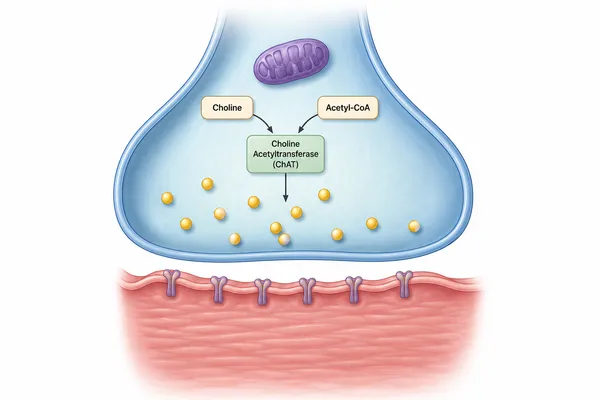
Nerves prepare acetylcholine, a chemical messenger involved in muscle and gland signaling.
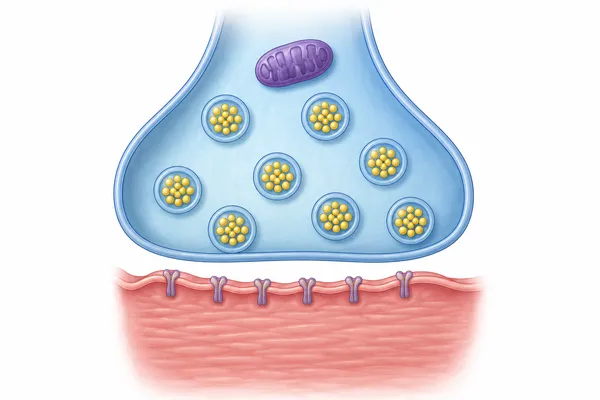
Acetylcholine is held inside vesicles, small storage pockets inside the nerve ending.
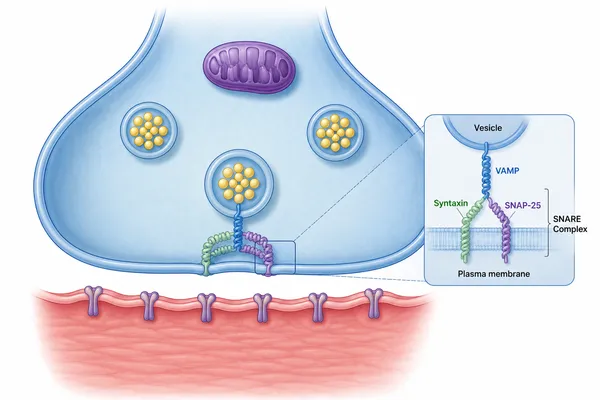
The SNARE complex helps the vesicle attach to the nerve-ending membrane so acetylcholine can be released. SNAP-25, syntaxin, and VAMP work together in this release machinery.
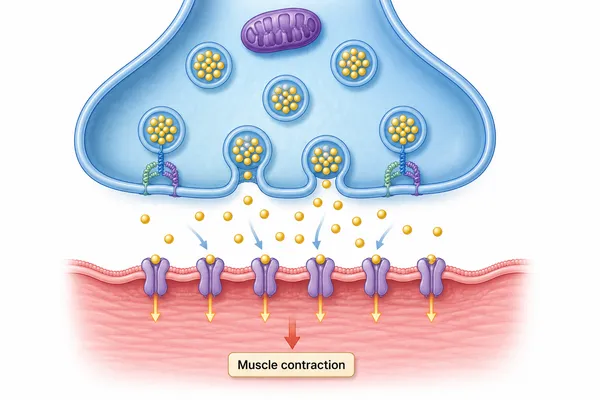
Released acetylcholine reaches receptors on the muscle side, and the muscle receives a contraction signal.
How Botulinum Toxin Interrupts The Signal
Section titled “How Botulinum Toxin Interrupts The Signal”Botulinum toxin acts inside susceptible nerve terminals near the treated area rather than by directly weakening muscle or gland tissue.
The molecular sequence has four broad stages:
- Binding: the toxin binds to receptors on a susceptible nerve terminal.
- Internalization: the nerve terminal takes the toxin into a membrane-bound compartment.
- Translocation: the active light chain reaches the nerve-terminal cytosol.
- SNARE cleavage: the light chain cleaves a serotype-specific SNARE protein, disrupting vesicle fusion and chemical-signal release (Diverse binding modes, same goal: receptor recognition mechanism of botulinum neurotoxin — PubMed Central).
How does botulinum toxin reach the SNARE machinery?
Botulinum toxin first binds to selected cholinergic nerve terminals. After internal entry, the active toxin component reaches the nerve-ending machinery involved in acetylcholine release. The effect is not simple surface contact with tissue.
How does botulinum toxin type A work?
Botulinum toxin type A cleaves SNAP-25, a component of the SNARE complex. Without functional SNAP-25, acetylcholine cannot be released efficiently.
How does botulinum toxin type B work?
Botulinum toxin type B cleaves VAMP, also called synaptobrevin, another component of the SNARE complex.
How does botulinum toxin type E work?
Botulinum toxin type E cleaves SNAP-25, as type A does, but at a different site. The shared target does not make the serotypes or their product units interchangeable.
The broad endpoint is similar: acetylcholine release is reduced. The clinical meaning still depends on the product, dose logic, target tissue, indication, and regional label.
That serotype distinction is one reason type A vs type B should be read as a biologic and product-context comparison rather than as a simple ranking.
The resulting temporary chemodenervation is a functional reduction in nerve-driven activity. It does not mean the nerve is permanently destroyed, and it does not make every use of botulinum toxin clinically equivalent.
Motor, Gland, And Sensory Context
Section titled “Motor, Gland, And Sensory Context”Acetylcholine blockade at cholinergic nerve endings explains the clearest shared pathway for reduced muscle contraction and glandular secretion. This pathway supports treatment contexts that include movement disorders, sweating disorders, glandular treatment, and aesthetic facial treatment.
Some product-specific uses involve additional sensory-neuron context. In chronic migraine, for example, onabotulinumtoxinA is understood to affect SNARE-dependent release of neurotransmitters and neuropeptides from peripheral sensory neurons, including mediators associated with nociceptive signaling. The precise clinical mechanism is not reduced to muscle relaxation or acetylcholine blockade alone (Mechanism of Action of OnabotulinumtoxinA in Chronic Migraine — PubMed Central).
The mechanism explains the shared biologic logic. Product-specific labeling and evidence determine how a particular treatment context should be interpreted. The pathway also helps frame related topics such as diffusion, immunogenicity, and type A vs type B.
References
Section titled “References”- Diverse binding modes, same goal: receptor recognition mechanism of botulinum neurotoxin
- Botulinum Toxin - StatPearls, NCBI Bookshelf
- Pharmacological differences and clinical implications of various botulinum toxin preparations: a critical appraisal
- A molecular basis underlying differences in the toxicity of botulinum serotypes A and E
- Mechanism of Action of OnabotulinumtoxinA in Chronic Migraine: A Narrative Review